MPLS "No Label" vs "Pop Label"

I like MPLS. And I don't necessarily mean as a solution to solve a problem, but as something to configure in the lab. It's fun to build things that do something when you're done. Setting up OSPF or EIGRP and being able to traceroute across routers is meh. But configuring MPLS with all the associated technologies β€” an IGP, LDP, MP-BGP, β€” and then getting all of them working in unison... when you get the traceroute working, it's rewarding.

Here's something to keep an eye out for when you're troubleshooting MPLS: An LFIB entry (that is, the Label Forwarding Information Base) that states "No Label" versus one that states "Pop Label". These mean very different things and can be the difference between a working Label Switched Path (LSP) and a non-working LSP.
Read more β†’

Walking with Packets: Traceroute Through MPLS Cloud

Think about this for a minute: An MPLS network with a two Provider Edge (PE) routers and some Provider (P) routers. The P routers have no VRFs configured on them and therefore have no routes whatsoever for any of the customer networks. A customer then does a traceroute from one of their sites, across the MPLS cloud, and into one of their other sites. The traceroute output shows the P routers as hops along the path.

How is it possible for the P routers to reply to the traceroute if they don't have routes back to the customer network?

Read more β†’

OS X -- Outlook Search "No Results"

The worst feeling for a geek:

Courtesy of

This has happened to me twice now: upgrading Mac OS X from one release to another and after the dust settles, the search function in Outlook 2011 totally breaks and always returns "no results". As we all know, email sucks and being able to deftly search through that mound of crap in your mail client is the only thing that makes it somewhat bearable.

Read more β†’

Lab: iBGP and OSPF Traffic Engineering

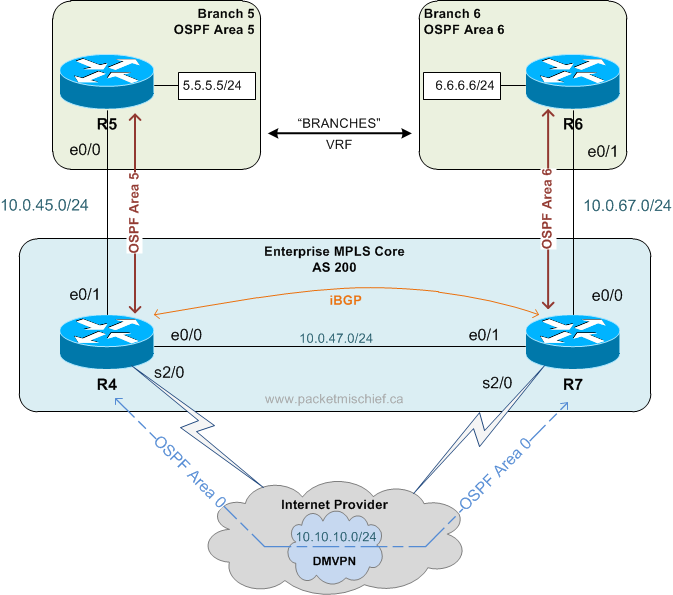
Click to enlarge

Here's the scenario: An enterprise network with an MPLS core and two branch locations connected to their own Provider Edge (PE) router. In addition to the MPLS link, the PEs are also connected via a DMVPN tunnel. The PEs are peering via iBGP (of course) and are also OSPF neighbors on the DMVPN. Both Customer Edge (CE) routers at the branch are OSPF neighbors with their local PE.

Task: Use the high speed MPLS network as the primary path between the CE routers and only use the DMVPN network if the MPLS network becomes unavailable.

Question: Is the solution as simple as adjusting the Admin Distance (AD) so that the iBGP routes are more preferred?

Read more β†’

Choosing a Route: Order of Operations

In Cisco IOS packets are forwarded through the router (or Layer 3 switch) by Cisco Express Forwarding (CEF). A data structure called the CEF table contains a list of known IP prefixes and the outgoing interface that packets should be put on in order to get them onwards to their destination. That's well and good. But how do the IP prefixes make it into the CEF table? To answer that question you have to work backwards and understand the order of operations that IOS goes through in order for a prefix to make it into the CEF table.

Read more β†’

Role Based Access Control in IOS

I don't believe this is well known: Cisco IOS has Role Based Access Control (RBAC) which can be used to create and assign different levels of privileged access to the device. Without RBAC there are two access levels in IOS: a read-only mode with limited access to commands and no ability to modify the running config (also called privilege level 1) and enable mode with full administrative access. There is no middle ground; it's all or nothing. RBAC allows creation of access levels somewhere between nothing and everything. A common use case is creating a role for the first line NOC analyst which might allow them to view the running config, configure interfaces, and configure named access-lists.

Read more β†’

What the *, traceroute?

If you've ever done a traceroute from one IOS box to another, you've undoubtedly seen output like this:

R8# traceroute 192.168.100.7
Tracing the route to 192.168.100.7
VRF info: (vrf in name/id, vrf out name/id)
  1 192.168.0.1 4 msec 3 msec 4 msec
  2 192.168.100.7 4 msec *  0 msec

That msec * msec output. Why is the middle packet always lost?? And why only on the last hop??

Read more β†’

IPv4 QoS Markings Calculator

This is a quick calculator I came up that I could use in the CCIE lab to translate between various IPv4 header QoS markings. As long as I could remember how to draw out the calculator, all I had to do was some basic math and I could translate between markings quite easily.

Read more β†’